Monday, March 12, 2018

Black Coffee

12 bar blues with an 8 bar bridge

A lady vocalist at the Sunday jazz jam thoughtfully provided a chart, from a fake book, for “Black Coffee.” In another era it might be described as a “torch song” - familiar repertoire. But we stumbled through the backup, failed to give her audible clues to where it was going, and part of the problem was the irregular layout on the page required to accommodate the lyrics, missing staff lines that made low Ab and F look like Fb and D, no “D.C.” and 1st and 2nd endings were not clearly marked. A few moments study before we plunged into it could have saved all of us some grief. And we should have checked her key. The chart was in F, and looking at YouTube videos before writing this: Sarah Vaughan in Db, Ella Fitzgerald - key of C.

It’s important to remember that a chart is nothing but an aid to memory, a guide, a road map. Written music requires an artist to understand, interpret and deliver an emotional interpretation, somehow intuiting and even improving upon the composer’s intent. Check out author Carole King, honored at the Kennedy Center, as Aretha Franklin starts into “Natural Woman” - that’s what I’m talkin’ about! The point is, don’t be slavishly bound to the written representation - the chords are but a guide and there are elements of melody open to interpretation in the worlds of jazz, pop, rock and blues. Here’s some analysis I wish I had done before attempting Black Coffee the first time!


The blues scale is defined as 1-2-b3-4-b5-5-b7-1, and yet the “one chord” often contains a natural 3. That’s where art comes into play, reconciling the juxtaposition of 3 and the “blue note” b3. The initial chord of a blues may be I7, or a minor chord, or a dominant 7 with #9 - it can even be a major triad or a I Maj7 as in some of the more harmonic jazz blues. The move from I7 to bII7 is not uncommon as a vamp or element of the chord progression. Stormy Monday Blues with great guitarist Wayne Bennett interpreting T Bone Walker is a quintessential example of the use of bII in the blues.

Back to Black Coffee, the passing chord at the end of bar 4 slides down a half step to the IV9 in measures 5 & 6. IV9 can also be thought of as minor i6 over the 4 of the key as root - minor sixth chords are a mainstay in the jazz and blues idioms. Then it’s back to the I - bII “vamp” feel in measure 7. Measure 8 shows a I7+9 again which then moves down a minor third to a VI7+9 - this begs for a chromatic root movement - or perhaps one could use I-bVII down to the VI7b13 that occurs naturally in the key. The function of the VI chord here is to set us up for a “jazz blues” cadence, the ii-V in measures 9 & 10. Out of the several options we have for realizing a ii-V, the composer chose to keep the iim7 sound for two measures while the bass moved to 5 of the key in measure 10.
 

Trying to read the composers intent, on the piano I wouldn’t play all the sharp nines, just use the 7th-3rd tri-tones in the left hand to realize the parallel I-bII chords. The melody and solos - just play the blues. The blues scale always works against I, IV7 and V7 - don’t bother to analyze why! The 13th chord on beats 3-4 of measure 4 seems unwieldy - parallel 9th chords from bV to the IV9 could work, too. Bar 5 & 6, the (I7) blues scale against the im6 (over 4 in the bass), and the blues scale continues to work until the minor third root movement down to VI7. Almost any VI7 alt scale will offer a delightful dissonance that could resolve to IV Lydian in measure 9 (against the vanilla of the ii), and using the blues scale against the V7sus sound of bar 10 brings us right back home to the I chord destination in measure 11.

After landing on the I, the 1st ending featured a turn-around, although most recordings just use the I-bII vamp here. The move to VI7 on beats 3-4 of bar 11 could be done chromatically. The ii on beats 1 & 2 of bar 12 moves quickly to a C7 “alt” (which could be considered an inversion of bII Lydian dominant). Repeat the 1st 12, and the 2nd ending finalizes the return to the tonic before the accent chord on beats 3-4 of what is now measure 24. One could easily realize measures 23-24 as I7-IV7-I6-bV7 augmented. Or use I7-bII7-I7-bV7. Looking at my block chart, "B1" is way too complicated - instead, use the key changes of "B2." The lead-in bV chord (beats 3-4, bar 24) is actually a bIII in the new key.


The principles in this well-written blues are fairly universal. The modulation up a minor third to go to the bridge, and the two places where I moves down a minor third employ a principle known as Lender’s Rule. I first heard about this in a lovely book that discussed the writings of Duke Ellington and Billy Strayhorn - I wandered into the library and found this detailed technical discussion of “who wrote what” - and it takes an almost forensic analysis to figure out what part of an arrangement came from each man. Even some wholly original Strayhorn tunes were credited to Ellington because he won the rights in a poker game or on a bet! Strayhorn often modulated by minor thirds, or even a tri-tone (3 whole steps), which is a distance of two minor thirds. Lender’s rule states that because a dominant chord with a flat nine lends itself to a diminished scale, there are four roots possible. For example, the scale for C7b9, C-C#-D#-E-F#-G-A-Bb can be used against roots C, Eb, Gb (F#) and A. Hence the most sonorous modulations go to bIII, bV (#IV) and VI.

So the Bridge starts on the ii chord of the key that’s up a minor third. Pause a moment to digest that - to “metabolize it!” We’re moving from the I chord of the home key, going up a third (m3 understood in that phrase), and when we get to the new key we’re landing on ii, setting up the key with good old ii-V-I, except that in relation to the old key (where the song started) it’s iv-bVII7-i minor. It’s good to realize the root movement from I to the ii of bIII is up a fourth but it would be patently wrong to continue with that logic. Look at how complicated B1 gets - we’re leading ourselves in the wrong direction - the chord roots make even less sense as we go along the errant path. If a song seems too complicated, we’re probably not onto the organization scheme. It’s always based on the same principles. To the tune of Wilson Pickett’s 634-5789, it’s 4-7-3 6-2-5-1! We’re always looking ahead, leading to the next downbeat, concluding a phrase, or playing up to the one. The joy and the challenge for us is to use the same tools, but to develop individually different approaches and answers within ours agreement on the tonality. We converse within a language. Like James Baldwin said, “The blues is a conversation, it’s not an argument.”


That’s a lot of text just to get to the bridge - which is strikingly in quite a different mood, and starts in a new key up a minor third. Here we go, we’re in the new key now: ii chord-dominant chord, surprise chord vi. Then vii half-diminished to III7b9 - or is this a V7 of the old key? Yes it is, we’re back to the old I chord - play it real pretty, now! That’s the first four of the bridge. Looking ahead, we’re going to modulate again. This time the key only moves up a half-step, measures 5-6 of the bridge are simply ii-V, I-vi. When modulating a half step up using a ii-V-I, the root movement from I of the old key is up a minor third - Lender’s Rule again - a pleasing root movement. We continue on with a parallel ii-V action, the 8th measure of the bridge drops down a half step compared to bar 7 and takes us back to the original key. And it’s a vanilla ii-V (does it have to be vanilla?) that sets up the return to the I7-bII7 vamp.

Da Capo - return to the head. Play the final A section, and conclude - create a Fine [
fi'ne or fine’ ?]. Or use the first ending to go back around again through the whole form. If invoking the D.C., measure 43 is a logical place for a I6, followed by some kind of a turn-around. If finishing the tune, maybe use the second ending and delay the I6 to bar 44, stopping short of the "pivot chord." A A B A in a “blues with a bridge” will be 12, 12, 8, 12 for a total of 44 measures. Sections start with: bar 1, bar 13, 25, 33. Sections are 1-12, 13-24, 25-32, 33-44. IV chord on the 12 bar blues measure 5, measure 17 etc... bla bla bla - there should be some kind of reward if you’ve read this far! And no, I don’t get paid by the word! I don’t get paid at all. But I have an "SSA grant" that makes my nut and allows me to do this!

New York

Thursday morning, October 11, 16 Bingtones boarded the jet at SFO, destination Buffalo, via JFK. You know something's up when your plane begins going in circles over Lake Michigan. At first we were early, but we doubled back between Detroit and Chicago and the truth came out. There was a giant rainstorm and JFK was closed. We circled some more over Lake Erie, tantalizingly close to Buffalo, then we landed at Pittsburgh to refuel. We got to JFK a couple of hours after our connecting flight was canceled, and no one at Delta (Don't-Ever-Leave-The-Airport) knew what to do with us. Our luggage was located, and we ended up boarding a bus (!) at 11pm. As luck would have it, the bus had no heater, so we drove all night huddled in our seats while trumpeter Ken Landreth wiped the inside of the windshield and kept the driver awake.
We arrived in Buffalo at 7am Friday morning, some of us grabbed breakfast, and most everyone slept until mid-afternoon. Road manager Mike, sound engineer Alan, Bing, Jerry, Mark, and Bob started setup while some of us were still sleeping. Things began to improve at "Club Infinity." The sound check was smooth since they have a permanent setup there with monitor board on stage, main mix in a raised booth off to one side, large dance floor, permanent lighting. We even had our horn riser for the brass, and before too long sound check was completed and we boarded our two vans and headed to "Bing's," their family restaurant (named after Bing's late father).
The trip was a reunion for Bing. His sister Debbie treated us all to a classic Italian dinner: salad with a lovely vinaigrette, pizza squares (gourmet style) and plates of scrumptiously prepared steaming hot clams for appetizers. The main course was mouth-watering pasta with the most subtly flavored meat balls, man it was great! A bittersweet reunion, for Bing's sister Edna had lost her husband 6 months before, and the purpose of our journey was to play a benefit. After a truly warm and exceptional time at the restaurant, we went back to the Holiday Inn and prepared for the evening.

Friday, February 16, 2018

Naima

...as a Latin groove

This arrangement has been "stage tested." Unlike the original recording - there are no pedal tones! The bass progression and chord inversions are the result of careful consideration. A little rehearsal and the intention of the arrangement will become clear. Discussion is in the key of Ab. Block chart references Roman numerals - note there many chords on the flat scale degrees, i.e. bIII, bII, bVII, bVI. Whether they are dominant chords or major, their accompanying scales will have #4 - with the exception of the bIIIs in the bridge - Ionian with 4 as an "avoid note." The bridge could be thought of as a temporary modulation to bIII.

The last 4 bars of the A section ("cadence") are used as an intro and as a tag at the end. The first two chords are basically dominant 7b5 (7+11) chords, the melody is on the 13th. They could be voiced as "slash" chords: AMaj7+4/B and GMaj7+4/A.
The verse, letter A, starts with a Bbm7 (ii chord in Ab) that could be voiced as a Db triad over Bb in the bass - melody on C would be the 9th of a Bbm or Maj 7 of a Db chord. The second chord, GbMaj7b5, could also be considered as Ebm69/Gb, a bit of experimentation should yield the best inversion(s) for this one. Last 4 of the A section was used for the intro.

The bridge merits some discussion. First, the harmonic rhythm is sped up. The first 6 bars took 12 measures to realize in the ballad version. BMaj7 can be voiced as Ebm7/B, the Bb7 might be realized as a Bb13 (AbMaj7b5/Bb) - whatever "lays" best on your instrument. Measure 5 of the bridge, E7b5 (Lydian dominant) supports a high C# (13th of an E7), a DMaj7b5/E would work. The E7b5 is an accent chord, foreign to the progression, it doesn't, lead to another chord, so the goal is to "relax" back to the BMaj7 in bar 6.

Measures 7-10 of the bridge are back to the original harmonic rhythm (borrowed from the ballad version). The Fm7 (melody is on the 9th) inversion is maintained for two measures while the bass walks up to Bb. Drums (and other percussion) buoy things up with accents under the Bbsus, two eighth note pick-ups and long sustain on the Gb13 "surprise" chord. (EMaj7b5/Gb? Press roll bar 9?) Backing up for a moment: the bass anticipates the Bb ("an" beat of 4 in meas. 7) and remains on tempo in bar 8. Bar 9 could be 8 eighth notes on the root - and a ninth eighth note would mark the downbeat of measure 10. Then the whole orchestra gives up a grunt ("huh!") on beat two of measure 10. Drum pick-ups return us to the last A...

Simply repeat A A B A until solos are done, repeat the melody and continue on to the "Coda" which consists of a tag (repeat the last 4 two times) - and then there's a series of 3 plagal resolutions (church style IV - I), and a ritard to the final I chord. Drums control the ending!

Thursday, February 15, 2018

Nardis

Miles Davis or Bill Evans? There has been much conjecture over who composed Nardis, but Evans himself allows that it was Miles who wrote it, even though it is more a part of Bill Evans' discography. Some of Bill Evans' titles were anagrams: NYC's No Lark = Sonny Clark (try a Sonny Clark station in your Pandora!), Re: Person I Knew = Orrin Keepnews (founder Riverside Records). My guess is that Nardis is simply "Sidran" spelled backwards (pianist/vocalist Ben Sidran). I visited jmeshel.com to research the authorship. It was "jazz song of the week" in post #124, Jan. 13, 2012, https://www.jmeshel.com/124-bill-Evans-nardis/ a fascinating read.

At first glance it seems like a crazy hodge-podge of chords. The concluding major chord moving to minor on beat 4 of the next to last measure makes one wonder, is it supposed to be Middle-Eastern? But, apparently it's from Miles' modal period, so let's do a quick analysis and determine a best approach to playing this captivating tune.

My guess is that it's in Phrygian mode, based on iii of the key. The move from iii to IV, measures 1-2 is reminiscent of  "The World Is A Ghetto" by pop R&B group War. The VII chord in bar 3 is V of iii, with the I chord of the key sounding a lot like bVI of the iii chord in measure 4. Then 5 through 8 are still modal: vi-IV-III-iii. The major III chord in bar 7 is a classic use of a "surprise chord."

The bridge is vi-IV-vi-IV followed by ii-ii/V-I-IV. Another way to characterize the whole song would be to treat the Phrygian iii (which serves as a tonic) as though it were a minor i. Normally, it's preferable to think of minor key pieces in relation to their relative major because one rarely encounter unfamiliar progressions as minor harmony often transits to relative major. But just for fun, here's how Nardis translates if we make the Phrygian chord our root i:

                i-bII-V7-bVI    iv-bII-I-i    (rpt. 8)  
bridge:  iv-bII-iv-bII   bvii-bvii/bIII7-bVI-bI

Treating  iii of the key as if it were i introduced a minor bvii and several awkward chord shifts that don't confront us if we just relax and play in the key. After all, that's what modal is all about!

The rhythmic punches throughout the tune are very important for underlining the melody. Don't make it too complicated - a slow count, 2 beats per measure makes the quarter note anticipations into simple upbeats, and eighth note anticipations are simply a small omission from sixteenth note patterns. There's a triplet figure on beat 1 in bar 7 that could also be thought of as a quarter note shake or "turn" - helping us realize that measure 7 is merely a basic quarter-half-quarter syncopation, or eighth-quarter-eighth if counting in cut time.

The Masquerade Is Over


Please don't confuse this with George Benson's "This Masquerade." This is from the Great American Songbook, and there are many great recordings of The Masquerade Is Over. Nancy Wilson did it as a ballad with the Cannonball Adderley Quintet, and it has been recorded by Sarah Vaughan, Carmen McRae, Etta James, Aretha Franklin, Al Jarreau, Jimmy Scott, even George Benson - and this is not a comprehensive list! Instrumentally it's known as an alto sax tour de force: Sonny Stitt, Jackie McClean, Lou Donaldson, Sonny Criss among my favorites. Tenor players Gene Ammons and Ike Quebec did it, too.

In the late '50s Blue Note released jazz 45s (in addition to 33s) and many recordings featured Ray Barretto on congas. Lou Donaldson's Masquerade Is Over was one of them - always on the play list in my buddy Bill's '54  Buick, a two door hardtop with a "rake." Before 4 track tape, and before 8 track tape, you could have a 45 player in your car. The records played upside down and as each one finished, the spindle "keepers" opened just long enough to allow the record just played to drop down on a catcher tray. Coincidentally, one could find cookie cans at Walgreens that held 45s perfectly with just the right amount of margin around the edge. Passenger in charge of programming...

Masquerade Is Over was recorded in either F or Eb by the alto players, and I would guess that vocalists were all over the map when choosing their key, so here's the chart in Roman Numerals. There's a version by Lou Donaldson out at YouTube with his solo neatly transcribed!
Full title, (I'm Afraid) The Masquerade Is Over, is an A A B A form but it's 16-16-8-16. The first 12 of the A section are the same every time but the last 4 change, so there's 1st, 2nd and 3rd endings (3rd written as a Coda). If one simplifies all the ii-Vs to just the dominant chord, breaking the song into 4 measure chunks, here's what you get for the first 12:

    I-III-II-I7    IV-VI-II-V    I-I7-IV-bVII. 
     (remember bVII can "relax" back to I.)

First ending is a iii-VI-ii-V turn-around. 2nd ending has a quick iii/VI-ii/V in measures 29-30. The minor iii in measure 13 and 29 is a "substitute for I." 

Measures 31-32 rest on the tonic and a VI7 on the last two beats of bar 32 sets up the bridge that will start on ii. Note the bVII on the last two beats of bar 31 - sometimes added by convention to spice up the return to I. It could be voiced as minor iv/b7. Alternately the last two beats of 31 could be bVII-natural VII, a chromatic return to the I in bar 32.

The first 4 bars of the bridge can be simplified to V7-VI7-V7- Major I (again by ignoring the minor 7th chords preceding the dominants). Then in a surprise move the 1st chord in bar 5 of the bridge is a #iv half-diminished, a tritone away from the I. In the original key the second half of the bridge starts out #ivb5/VII - iii/VI9 - vi/II7 - ii/V to return us to the I of the A section. It can also be thought of as a sudden modulation to II Major: quick ii-Vs on VI7-V7-I7 in the new key followed by a quick ii/V in the original key.

The "Coda" (3rd ending) is similar to the 2nd ending but the I chord is more conclusive. With the 16-16-8-16 format, the very last measure becomes bar 56 - optionally a quick ii/V starting the song over for soloists or a final return to the melody. If there's a tag at the end, measures 53-54 would repeat. Ultimately, it's easier to play than describe, but sometimes it pays to zoom out and look at the overview.

Monday, February 12, 2018

Peace

Horace Silver

Although Horace wrote and recorded Peace as an instrumental in Bb, there is a wonderful vocal version by Lonnie Liston Smith. Donald Smith's vocal is splendid, and it was necessary to move to the key to C to accommodate his low G at the end of the piece.

The L. L. Smith version features a split keyboard allowing a string "wash" to complement the vocal, creating a 70s fusion feel. A lovely ballad with a great message - Horace wrote lyrics to many of his songs even though they were recorded instrumentally by his combo.
I've puzzled over exactly what is the guiding harmonic thought on the rubato beginning and the ending chord that allows the F# on the I chord (C major). My workaround is to simply use Bm/G (G Maj7) for the intro and ending chord. It might be considered as Cmaj7b5 but I think G Maj7 works OK.

The song is 10 measures at a slow tempo. At first glance one wonders, "how can I possibly remember this?" But after a few repetitions it becomes an easy and fun piece to play. I find it advantageous to look at this song in two measure segments:
After the initial rubato chord, letter "A" starts in the key of C major. The vocal pickup leads to an F natural, and the first chord is the vii of C major followed by an E7 altered dominant (V7 of vi minor) on beats 3 & 4. In measure 2 we get an Am7 followed by an Ab7. In the key of C that Ab7 would be a Lydian dominant leading down a half step, and instead we get a "surprise" chord to start measure 3.

Measures 3 & 4 feature a quick modulation back to C major after a short visit to Db major on the first two beats of bar 3. Beats 3 & 4 are a quick ii-V going back to C major in bar 4. The ii-V looks like it's going to resolve to Cm because it's vii-III7alt of Eb (relative major of C minor) and the C major chord of measure 4 is again a "surprise" chord.
The bass moves up a half-step to start measure 5 on a C#m9, beats 1 & 2, followed by an F#13, beats 3 & 4. The C#m9 could be voiced as E Maj7/C# and the F#13 could by voiced as E Maj7b5/F# - the only moving tone between those two chords would be B natural to B flat (A sharp of the F#13).
Measure 6 can be played several ways. First time around use a descending bass line B-A#-G#-F# under a B major I chord. Second time stay on B two beats then use the same descending run B-A#-G#-F# as eighth notes. A third method, behind solos, don't use the walk down...

Measures 5 & 6 were in the key of B major. Measure 7 is a modulation to Eb major. The F half-diminished is like a ii chord in Eb minor (vii of Gb) , but the choice of Bb13b9 leads nicely to an Eb69 for a I chord - again, a surprise chord. The listener was set up for a modulation to Eb minor but instead receives a lush Eb major. After a long slow 8 bars all that is left is to modulate back to C major.

Magically, in measure 9 we can evoke a vii-III7alt in the key of Eb (Dm7b5 --> G7alt), 2 beats on each chord, and then we're back home to C major as a surprise chord (instead of C minor). And we choose C Maj7 to represent the I chord for the four beats of measure 10 - although C6 or C69 could also work to define the "home" chord.

The last time through do a rubato repeat of measure 9 with fermatas over the Dm7b5 and G7alt chords. Follow the singer carefully, it's a long descending run to a low G! Then use Bm/G as the last chord. Peace!
By the way, these charts are saved as jpegs, and they can be easily downloaded.

Señor Blues

I don't post copyrighted material, but this is a handwritten harmony part, and it's not for profit, instructional only. If one counts slowly, Señor Blues is indeed a 12 bar blues. If the triplet eighth notes are at 120bpm, the slow count would be 40bpm - much easier for the horns to conceptualize in slow 4/4 with a triplet feel! Reading the part is much easier in 12/8 compared to 6/8 because of fewer bar lines...
In the key of Eb minor, the minor i chord is voiced as an Ab13, from the bottom up Gb, Bb, C, F. That's on the piano. For guitar, those are the notes you want in your chord, call it an Ebm6/9 - the bass pattern emphasizes the root.

Measure 5 & 6 of this blues use a B13 chord (actually a Cb chord in the key signature) so on the piano one would simply move the 1st voicing up 3 half-steps. Maybe moving 3 frets up on the guitar would work. (Gbm6/9 over Cb in the bass?!) Measures 7-8 are back to the same pattern, same inversion as the first 4 bars.

The cadence in meas. 9-10 is simply Bb7 - Ab7 and back to Ebm(6/9) with no turn-around. The Bb7 and Ab7 sound fine with no third - and they also sound good as tri-tone voicings (3 and b7). More than a little finesse is required here.

Measures 11-12 are "on the one" - and there are sections of the tune arranged to stay on the minor i vamp. Pianist Horace Silver wrote it - upright bass players get cramps from the brutal 12/8 ostinato! There are a couple or three different recordings of this by Horace, one has a vocal by Bill Henderson. Taj Mahal did a good version, and vocalist Mark Murphy also did it (in C minor).

Wave

Antonio Carlos Jobim

It's in the books in the key of  D, basically a guitar key, and considering the Brazilian roots of this tune, that makes sense. But a key change is in order when converting to a straight ahead jazz tune. Dexter Gordon recorded Wave in C (D for tenor sax) and Paul Desmond recorded it in F (D for alto sax). Consider it in key of C, and that also helps the comparison with the Roman numeral version.

Interestingly, it's a 12 bar A section, 8 bar bridge. The 12 measure A section is analogous to the blues form. It's a bit of a stretch, but the comparison may serve as an aid to memorizing the progression.
The first 4 could be compared to a blues with a "quick IV" except the "IV" in measure 2 is shown as a bvi diminished chord - the notes in a full diminished on b6 are b6 - 7 - 2 - 4 of the key, several ways to realize that chord. The 8 tone scale for a full diminished adds 4 tones each a whole step above the given tones. The scale for measure 2 could be Ab Bb B C# D E F G. Measure 3 is a v minor, measure 4 a I7, as it would be in a 12 bar blues.
Measure 5 is a IV chord, measure 6 a minor iv - as in a blues where measure 6 sometimes is often altered to iv, bVII or #iv dim. Instead of a return to I in measure 7 the song goes to variations on III dominant (iii a substitute for I, so III7 is not such a stretch). The A7 (VI7) in measure 8 is a bit unconventional - but the cadence that appears in measures 9 & 10 is close to the spirit of the blues. A jazz blues would offer ii - V7 in measure 9-10. Jobim gives us a II chord to V7, modified by adding preceding chords, vim7-II9 followed by bVI9-V7 alt.
 
Instead of a resolution to I in measures 11-12 we get a shift to parallel minor, Cm7-F7 2 times - or more. As an option, later, say after the third time through A, one could extend the im - IV pattern to several repetitions, and the next soloist would take over at letter A!

The bridge takes us to ivm7 - bVII7 - bIII in the first 4 bars. Then either a parallelism of biiim7 - bVI7 - bII - V7(alt) in 5-8 of the bridge - or bIIIsus-bVI, bIIIsus-bVI, bII, V7(alt) to turn around for last A. In key of C the bridge is simply Fm-Bb7 Eb__,  Ebm7-Ab7 Db to G7+5 (or G7+9). I took some liberties and arranged 3-4 as the cliche of EbM7-Eb6 % (rpt) and instead of a long ii-V in Db measures 5-6 use Ebsus-Ab7 % (rpt)


So a full arrangement would be: Vamp in on Cm7-F7, A A B A, solos on A A B A with optional extended vamp at end of each solo, vamp out on Cm7-F7, maybe ritard to a C69 last chord.

Autumn Leaves

This one keeps coming up, regardless of the season. It's in relative minor to the key signature. One sharp (Real Book I) means E minor, and the first chord is A minor, so it's often misstated as being in the key of that first chord. The Cannonball Adderley / Miles Davis Quintet did it in G minor with an extended intro based on Gm6. Clark Terry, Chet Baker, Bud Shank recorded this in F minor, it's in newer fake books in G minor, and Tito Puente recorded a Latin version in C minor. Nat King Cole D minor for his vocal range...

Autumn Leaves may seem harmonically complex, especially if you've been playing a lot of three chord blues tunes, but it's actually not that tough. It might be a good exercise to learn this one in all twelve keys, and once one does a little analysis, the logic of the harmonic "skeleton" becomes clear.
The first four measures are actually in the major key presented by the key signature, simply ii - V - I and a "flip" to the IV chord in measure 4. The second set of four measures is a ii - V - I going to relative minor, best represented as vii - III - vi in the key. Melodically, just a slight variation at the conclusion of the 8 bars, 1st and 2nd endings.

An effective device on the bridge is to use a pedal tone on 5 of the relative minor for measures 17-20. Although the sheet music shows it as vii - III - vi, it could be realized as two bars of III7 "alt" (#9 b9 #5 #11) or III7 harmonic minor (b13, b9) followed by two bars on the relative minor referenced to 5 of vi. And 17-20 could also be done as 4 bars of III7alt. Once through the first four bars of the bridge it's simply a ii - V - I (in the major key) with a flip to IV at the end.

Autumn Leaves is an A A B C format. The last 8 (measures 25-32) require a little more thought than the previous 24 bars, and letter C is more closely allied to the B section than the earlier A sections. The first two measures of letter C are a ii - V in relative minor, vii - III7 of the key. Measure 24 was a IV chord, and the bass moves a tri-tone away to the vii chord in bar 25 to kick off the last 8. There's a little bit of sauce in measures 27 and 28, as the chords move from vi in bar 26 to IV in measure 29...
Once the vi (relative minor) is sounded on the first two beats of bar 27 then the next three passing chords are either realized as a descending chromatic progression bVI7 - v - bV7 or as the sequence II7 - v - I7. The IV in measure 29 is followed by vii - III in measure 30 and we arrive home on a vi6 in measure 31. Optionally, one can use a VI7 in measure 32 to turn around back to the ii chord of measure 1.

For an extreme shorthand way of thinking about Autumn Leaves: The A section is repeated and it's simply four bars in major, four in relative minor. Then the B section is four bars on V of relative minor, four bars of major. The only tricky thing is the last 8, and that's not so bad if you think of it as 8 bars in relative minor, four 2 bar chunks: vii - III, vi "passing," a IV - III7 cadence, and finally vi, the relative minor.

Sunday, February 11, 2018

Nica's Dream


The prolific, iconic Horace Silver crafted this one! A DuckDuckGo search on " Nica's dream Pannonica " yields several interesting references to the life of Baroness Pannonica de Koenigswarter (née Rothschild), legendary benefactor and contributor to the jazz scene. And the search should yield a LearnJazzStandards.com link to Nica's Dream, also.

This is likely going to be played in Bbm, I've never run across a recording in any other key. There are at least 3 different ways to do an intro for Nica's Dream. Recordings made at different times used different intros, check out Eddie Palmieri's Latin version. The "Colorado Cookbook" features the descending sequence BbmM7 - AbmM7 - GbM7 - Cm7b5 to F7(alt) punches followed by 7 eighth notes and a drum fill, used by organist Jack McDuff about 1:12 in, and at the end. It's important to note that some recordings vamp on one bar each BbmM7 - AbmM7, but when the melody starts it's two bars BbmM7, two bars AbmM7.

The minor with a major 7 is a difficult chord to sound properly. It basically implies a harmonic minor structure, but the sixth degree of the accompanying chord-scale could very well be sounded as natural 6, and often a minor i chord is written as m6 and M7 is an option. Taste and experience are the best way to gain confidence with this "exotic" harmony. Optionally, a major chord based on 5 of the minor chord will yield a mM9 sound. Other ways to realize mM7 include playing an augmented triad against the root, e.g. C#+5 (C# F A) and the bass plays Bb, and B+5 over Ab in the bass. The mM7 also shows up as a passing chord in the cliche of descending roots in minor: i - i/7 - I/b7 - i/6.
Now, let's think of the Roman numeral approach to Nica's Dream, remembering that Bbm is the relative minor in the key of Db. (Db is the easiest scale on the piano, thumbs on C natural and F natural, extended fingers on the black keys.) This means that the first six measures are parallel mM7 chords: vi for two bars, v two bars, vi two bars. Then measure 7-8 are essentially I7 realized as vm7 - I7. (The second appearance of Abm is not a mM7!) that's the first 8...

The second 8 measures start with a repeat of the harmony used in bars 7-8, Abm7 - Db7 in bars 9-10. The next figure (measures 11-12) needs to be rehearsed in order to be most effective. It's the same rhythm as the F punches of bar 5-6 in the stock descending chord intro, only a different chord on each punch: GbM7 - Db7 - C7+9 (IV - I7 - VII7alt). Once that passage is accomplished there's a sort of a discontinuity as the root stays on C for the move back to the minor i chord, Cm7b5 - F7+9 - Bbm6 comprise measures 13-16, completing the A section with good old vii - III7 - vi. The A section repeats before we get to the bridge - same material, no 1st and 2nd ending.

Letter B, the bridge is in swing tempo, a contrast to the Latin feel of the A section. It's popularly termed a "Latin-Swing sandwich." the 8 bars of the bridge repeat using 1st and 2nd endings to make it a full 16 bars. First two bars are punches on 5 of the key, beats 2 & 4: Ebm9/Ab 2x then Ab7 2x. It then breaks into swing with chords changing every beat, bars 3-4 are arranged, Db Ebm Fm_ Bb7b9_ _ _ Fb7 (E7+4), passing chord beat 4.

Measures 5-6-7 of the bridge are a stock progression, variation on II, ii-V, I. Eb9, Ebm7-Ab7, DbMaj7. The first ending (repeat back to letter B) is biiim7-bVI7, a vanilla Em7-A7 as a surprise interjection before hitting those punches on Ab (measures 1-2) again. After repeating 1 through 7 of the bridge the 2nd ending is a STOP on III7 followed by lead instrument pickups back to letter A.

Yes, there are punches and turn-arounds to rehearse, and the parallel minor with maj 7 chords are tricky. But the horns can relax and count in half time, drums (and percussion) take the faster architectonic levels, and chordal instruments can play accents and concentrate on developing moving lines that answer the lead phrases. A jazz classic, fun to play, good for the audience too because the arranged parts break things up, creating tension and interest.

Saturday, February 10, 2018

All The Things You Are

 Diz and Bird

No need to overdo the Roman numerals - just remember this one in the key it's commonly played in, Ab. Note the areas where it modulates to different keys, couple that with an almost subliminal sense for the harmonic motion and it's fun to play.

 A1:  Starts with vi-ii-V-I followed by IV and a quick modulation in bar 6 to new key, major III.

A2:  The section starts with minor iii of the key, a pivot chord acting as vi of V.  We moved up a minor third to the key of the V. Thankfully it's the same melody and changes as A1 - just based on 5 of the key.

Bridge:  The bridge was set up by the modulation in measure 14, establishing III of V as a new key.
So now we just relax and continue to groove in what is actually VII (!) of the original key, an easy ii-V-I in G major.

Measures 5-6-7 of the bridge (21-22-23 of the song) could have been a ii-V into relative minor, but (surprise) it's a ii - V going to major VI. Then, boom! Last measure of the bridge a crazy minor key ii-V, maybe a vii diminished or V7+5 whole tone... To set us up for a repeat of the original motif in the original key.

The extended A3:  Measures 25-28 col 1-4 (they're exactly the same, vi-ii-V-I in the original key Ab). Then the harmonic rhythm of the concluding two 4 bar sections is cool stuff. (A3 is 12 measures long.) The second 4 bars of A3 are IV-iv-iii-biii followed by a simple ii-V-I to Ab, add a turn-around to vi as required.

A few words about the famous intro / outro: Diz used Dbminor 9 to C7+9, and later usage modified this to parallel 7+9 (alt chords), DB7+9 to C7+9. A nice variation involves inserting a four bar tag. Starting measure 31, it would be iiim7b5 - V7b13 - ii - V... and instead of resolving to I - invoke the intro again!

The impetus that established All The Things You Are as a bebop staple came from Diz and Bird in their very hip and to the point instrumental, while Ella Fitzgerald owned the vocal. It's said that when Ella would sing out loud on the long bus trips, all the cats dropped their chatter to groove on her great sense of swing and impeccable intonation.

Tangerine

Tangerine was famously recorded by Frank Sinatra. It's a nice melody, easy changes to blow on... check out what tenor man Dexter Gordon does with Tangerine!


Monday, May 12, 2014

Bass Clef Melodic Exercises - free PDF

Three years in the making, I have a new method book soon to be published! 144 Daily Exercises - Developing Melodic Technique introduces a simplified system of tonal organization to encourage rapid progress in improvising and composing skills through a complete understanding of modes and altered chords.

It comes with an accompanying CD, taking practicing musicians through 12 sustained chords in 12 keys in just 30 minutes of concentrated, effective effort. The book includes treble clef exercises, pages 1-15. The bass clef version is offered here at no charge through profunk.blogspot.com out of my respect for those who choose to master acoustic bass, electric bass and other bass clef instruments, and it helps to avoid printing two versions.

In addition to the 144 Exercises, great effort has been applied to creating concise digested information: Writing Melodic Lines, Chord-Scale Theory, Chord Inversions, Patterns and Discoveries, Tri-tones Made Easy - all these are described logically and thoroughly. Quick Concepts offers many ideas for improvisation, and Power to the Etude is a guide that leads to composing and improvising your own etudes.

144 Daily Exercises - Developing Melodic Technique is 28 pages,
8 1/2 x 11, with the CD on the inside back cover. I don't know my costs yet, so it's too soon for pricing and distribution. Please watch my blog or send an email if you'd like to purchase an early copy!

For your PDF of the bass clef exercises, or more information please email profunk@sbcglobal.net or hiphermit@yahoo.com.

Sunday, April 20, 2014

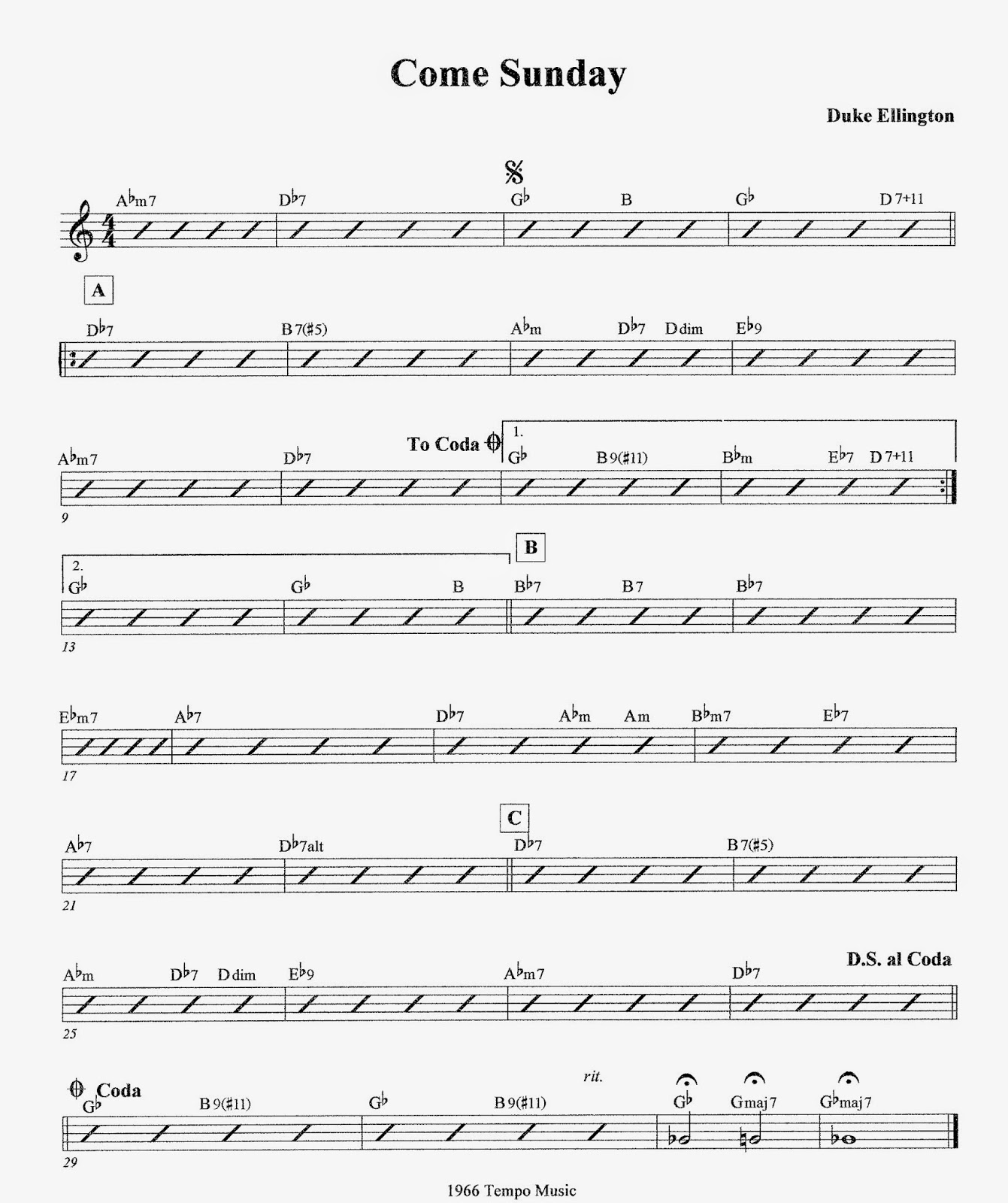
Come Sunday - Easter, 2014

Here's a transcription of  Duke Ellington's Come Sunday, as performed by Ben Webster on tenor sax, Oscar Peterson on piano. I had the privilege and pleasure to play this morning at New Vision Methodist Church in Millbrae, California. Choir director Craig Davis did a marvelous job, charting and arranging, assembling a jazz quintet to accompany the choir, leading the congregation through several selections from the hymnal, directing and inspiring us all. Come Sunday was chosen for a prelude to the service, and Craig graciously provided a transposed chart in Gb - and one in Ab for the tenor sax. We stuck with Craig's chart because of time constraints, but I took his chart home, doggedly compared it to the recording and developed a lead sheet for the tenor, and a chord chart for C instruments. In my previous post "Transposing a Step Down - Body and Soul" I mentioned the "Gb - F# conundrum." The Real Book chart is in Bb, we had to go two whole steps down to get this into Gb concert. Not a perfect transcription, but pretty close:


Saturday, April 05, 2014

Transposing a Step Down -- Body And Soul

Don't shudder when the band leader, tenor sax or vocalist says "Let's take it down a step." Take it down a step, and "Kick it up a notch!" To cite some examples: You Are Too Beautiful by Johnny Hartman and John Coltrane in Bb, Here's That Rainy Day by Gene Ammons in F, Wave by Dexter Gordon in C. We are often called on to lift something up a half-step, but to accomodate the range of the lead voice, one should be equally adept at shifting downward. And it's easier to move down by a whole step compared to a half-step because the key change is less radical. e.g. Here's That Rainy Day is in the books in the key of G, one sharp. Down by a half-step and you're immediately facing the Gb - F# conundrum of choosing 6 flats or 6 sharps. But down a whole step to F and F# goes away, Bb enters the picture. The written notes move down from a line to the space below, notes in spaces go to the line below. A couple of accidentals require special consideration, C# becomes B natural, F natural becomes Eb. There's only a couple of transposed notes that don't "follow suit" when you go down a whole step.

So just for fun, let's take one that is seldom moved to a different key because it's quite a study to learn it in the original key in the first place -- good old Body And Soul. Music by Johnny Green -- I hope his heirs have a hold on this copyright -- what a classic, well-crafted offering! Trane did not move the key on this one, but ya never can tell when a vocalist needs a little relief on the high notes, and I've discovered I get a better resonance on the lows and can easily make the high notes if it's a step lower. Heresy, blasphemy, I know -- Body And Soul in B natural -- please. Come on now, if it was Billie Holiday up here you'd move the key -- yeah, I know I'm not... -- but she sang in B sometime, just do me a favor, OK? I haven't tried the tenor sax in the lower key, yet, but landing on C# (either a thin, open fingering or all closed with the octave key) might be uncool. Anyway, let's consider navigating the change from Db to B natural -- which is one of the worst!
Above:  Step 1, found a nice, clear chart in New Real Book 2, borrowing their chord symbols, modified in a couple of places. Step 2, considering the scale degrees and key centers -- thinking "by the numbers."

Below: Step 3, look at the Roman numerals, simplify even further into "home" or "away," highlight the cliches. Then, Step 4, we can easily move to the new key. Remember, too, that the 1st 8 is good for a total of 3 repetitions. And relax, see the simplicity of the bridge -- two different keys -- a cliche in the middle, and a surprise modulation in the very last measure.
Looking at Step 3, the simplified Roman numeral chart -- first 2 bars an easy to remember variation based on the ii chord, measures 3-4 an easy pattern based on I. Then bars 5-6 are a slight variation on a typical minor chord descending bass. The III7 on beats 3-4 of measure 6 can be considered part of the cadence, bars 7-8: | vim7 / iim7 V7 | I6 / x y ||  The bridge is pretty sensible. Up the scale in the new key (a half-step higher - we got there from bVI7) || I / ii / | iii / iv / | then back down with a 3-6-2-5-1 action, that's the first 4 of the bridge. Then the common device of changing the I chord to a Dorian minor changes the key a whole step lower, and bar 5 of the bridge is just a ii-V. Then bar 6 goes to iii (sub. for I) and down a half step on beats 3 and 4. | iim7 / V7 / | iii / biii(dim) / | Measure 7 of the bridge another ii-V (the key we're in now is a half-step below the original key) then the quite recognizable modulation in the last bar of the bridge, parallel dominant chords on beats 1, 2, 3. That set us up to go back to the ii chord of our original key. Smooth!

Wednesday, April 02, 2014

Rhythmic Architecture, part 2

In the late 40s the beboppers began moving phrases in their solos to smaller divisions of the beat. The implied double-time of sixteenth notes gave new life to ballads, and new challenge to uptempo improvisations. Charlie Parker (for one) became so adept at rapid scalar quotations that his solos would employ 32nd notes against a slow overall tempo e.g. Embracable You, Out Of Nowhere. "Bird" along with his cohorts and competitors would dash off sixteenth note phrases at tempos as fast as 210 beats per minute, even the 300bpm of Anthropology, a contrafact using the chord changes from Gershwin's I Got Rhythm. There are versions of Cherokee as fast as 360bpm where the eight notes are best thought of as 16ths at 180bpm counted in half notes -- "Diz" (Dizzy Gillespie) said "The faster the tempo, the slower you count."

In the latter half of the 50s we began to hear "soul jazz" and "funk" borrowing from the church and contemporary dance styles influenced by slower tempos with a prominent 16th note feel. And conversely, dance styles greatly affected the music -- the Chicken, Stroll, Madison, Boogaloo, Temptation Walk, Watusi, Jerk, Monkey, Dog, Philly Dog replacing swing and bop styles. Much of the 50s music still featured triplets in 12/8, but the advent of 16th note styles brought new life to jazz, r&b and pop and became a hallmark of the Soul movement that flourished from 1955 to 1975. At the height of the dance and funk music symbiosis musicians and audiences celebrated the16th note pulse as the very definition of hipness. The thoughtful use of instruments playing a little more sparsely, accenting subdivisions of the 16th, juxtaposing a 12/8 triplet feel against the duple rhythms, characterized funk and presaged refinements that appeared later in the spaciousness of Jamaican Reggae. But, unlike Reggae, the possibilities of the electric bass are exploited fully in funk and fusion. Getting busy with complex lines juxtaposed against new rhythmic textures, sophisticated syncopation, 8 beat patterns and other devices, the bass assumes a new importance in funk.

Careful listening to seminal recordings from the heyday of funk provide us with great polyrhythmic examples. And the style is not hampered by tight requirements for the role of each instrument. One of the beauties of funk influenced soul is the diversity of arrangement made possible by the often invisible but everpresent 16th note as the basic pulse. Let's look and listen to the construction of a few of the marvelous 45s produced by the progenitors of funk...

Follow Your Heart by the Manhattans came out in 1965, with a carefully arranged rhythmic background at about 97bpm. The bass is augmented with a trombone unison, they provide a pickup on beat 3 using the basic syncopation pattern of eighth - quarter - eighth. They play a two measure pattern, the an beat of 4 (eighth notes counted "1 an 2 an 3 an 4 an") acting as an anticipated down beat, a common practice. The first full measure of the pattern is empty except for a single eighth on the an of 4 followed by 3 eighths "1 an 2" and the original pickup "3 an__ (4) an___". Actually, the last pick up note on the an of 4 is tied to a quarter on beat 1, bar 1 of the pattern. It might be better better to notate these rhythms rather than use the verbal description -- but the goal is to understand the architecture, and since it's funk we're talking about -- where are the sixteenth notes?

Follow Your Heart has a piano playing eighths instead of the old doo-wop triplets. The pianist fades in and out of the overall rhythm to allow accents from other instruments. In the intro there's a vibraphone that accents the backbeat on 2, then provides pickups to measure 2, starting with the an of 3, "an 4 an 1 an" coinciding with bass/bone on the first two eighths of measure 2, tastefully laying out on the backbeat of 2 in bar 2 of the 8 beat pattern. There's a "stutter" effect in the kick drum with some variation but usually emphasizing "1 an" plus the an of 3, and a pickup to the next measure on (4) an. Snare backbeat on 2, tambourine on 4. The chording rhythm guitar gets the backbeat on 2 but is most noticeable with a sixteenth note on the "e" of 3 (count "3 e an a" -- or "shook-a-took-a"), or it might be a triplet figure. There's another guitar playing single note eighths -- maybe it's just the incredible taste of a single guitarist. There is some room for individuality in these background parts, but everyone sticks pretty close to their assignment. The implied 16th note pulse is the unifying factor, and this can be heard in occasional departures from the basic patterns.

Here's a short list of some classic r&b, with a thumbnail sketch calling your attention to the architectural level of different instruments, and the exceptional rhythmic insight of the musicians on these seminal funk recordings:

Shoot Your Shot - Jr. Walker & The All Stars     113bpm -- guitar pattern 1 an 2 an 3 e an a 4 an, organ on 2 & 4, bass at the eighth note level (playing "up to the 1"), 16ths on the hi-hat.

Your Love (Means Everything To Me) - Charles Wright & The 103rd Street Band   94bpm -- snare drum is on 1 2 3 4, the kick drum does the accenting (3) an (4) an with some variation. Rhythm guitar has 16ths "1 e an a 2" rest 4. Saxes hint at triplet rhythms with their liquid pattern, punches are on 1 an with a subtle pickup an the "a" of 4 preceding.

I Got Love - Charles Wright & The 103rd Street Band  102bpm -- drum hi-hat has 16ths, snare is free to accent when not playing 2 and 4 per arrangement. The bass is so percussive that the kick drum seems absent. Rhythm guitar "2 e an a" accenting a 16th before the traditional backbeat of 3, and then next measure "2 e an" leaving out the last note, at least in the groove portion, not the arranged passages.

Southern Part of Texas - War (live on SoulTrain)  114bpm -- bass at the 16th note level, organ basically eighths but spicing things up with 16th punches and pickups. The conga is free to move between quarters, eighths and 16ths, horns play strict eighths alternated with a smoother phrase that hints at a quarter note triplet feel. There's so much going on that the drummer pretty much sticks to the backbeat on 2 and 4. There are arranged sections, too!

Rhythmic opportunities multiply when the basic pulse moves up to the 16th note level! Please visit my Funk Now blog at www.profunk.us for more selected r&b funk masterpieces from Charles Wright -- soon to be followed by highlighted short discographies from other geniuses of the genre such as War, Junior Walker, Sly Stone and some of the unsung heroes and one-hit wonders you will enjoy remembering or learning about. And this blog will conclude the 3 part series on Rhythm as Architecture in a week or two with some helpful hints for rhythm sections, engineers and producers.

Friday, March 21, 2014

Rhythmic Architecture, part 1

First, let me explode two common myths about musical structure. For one, the best way to create harmonies is from the top down. The top line has to be making musical sense, and this doesn't result often enough when "stacking" harmonies from the bottom. Another common concept that needs revising: thinking of rhythm from the bass up. To understand rhythmic structure, start at the fastest pulse and let different instruments express substructures and accents at lower levels. Many genres of music are defined by assigning separate levels of rhythm to various instruments. John Meheghan's second book, Jazz Rhythm and the Improvised Line  illustrates this well, and The Rhythmic Structure of Music by Grosvenor Cooper and Leonard Meyer has a broader, more scholarly focus on the "architectonic levels" of music.

In brief, one may employ duple or triplet rhythm as the most basic building blocks. Walking and marching beats are duple. Gliding and twirling motions are associated with the waltz, the original forbidden dance because of the intoxicating abandon that characterized its performance. Things get really interesting when we allow the spirit of African rhythm into our performance. The use of polyrhythms (more than one rhythm at the same time), especially two against three, greatly enriches the listening and dancing experience!

American musical history involves the weaving of many threads. In the days of the sailing ships, pulling up stakes and heading for the "new world" must have been like going to Mars would be for us today. The many cultures that contribute to our 21st century sensibility were originally kept intact for hundreds of years in the enclaves of immigrants and slaves. The homogenizing tendency of recorded music arrived in full impact around the start of the 20th century, blending folk and traditional elements in song form, harmony and rhythm. Early popular music of the two-beat variety gained energy from tempo and associated dance styles, and New Orleans ragtime and jazz began to infuse the culture with syncopation. The most basic syncopated rhythm is the quarternote - halfnote - quarternote pattern in 4/4 time. With the introduction of a strong beat on 2 and 4, the American "backbeat" was born.

Soon enough the boogie woogie pattern was sparking the dancers. Pretty much straight eighth notes, the major chord was spelled out with two eighths on 1, 3 and 5 for the first 3 beats of a measure in 4/4 followed by some variation on the last two eighths, often simply 6-5. Variations on the boogie pattern abound, providing impetus to composers in many genres which transcend the early stylistic requirements of boogie woogie and associated "barrelhouse" piano styles.

The advent of swing in the 1930s smoothed the stiff pairs of eighths into a triplet rhythm. Instead of a rigid 8 to the bar pulse, there was an implied pulse of 12 beats, with 8 notes sounded. Notation posed a problem -- triplets are written with the next smaller note division as a group of three. Now each quarter note (previously subdivided into two eighths) would have to be notated as either two eighths tied together followed by another eighth (with a bracket and the number 3 enclosing the group) or as a series of quarter-eighth groupings (again bracketed with a 3). Eventually the implied 3 eighths against the old 2 were spelled out as a dotted eighth followed by a sixteenth, the connecting bar solved the grouping problem (no unwieldy 3s cluttering the sheet music), and it was understood by convention that the dotted eighth and sixteenth pattern was to be "swung."

Next installment of this 3 part series on rhythmic architecture will be a study of early R&B, early rock, and the apotheosis of funk!

Thursday, March 13, 2014

Darn That Dream & Don Alberts...

Try to make things easier -- if it looks complex -- analyze it until the inner logic becomes apparent! For years I would avoid playing Darn That Dream. Songs that change chords every two beats, or worse, every beat -- too much for me -- and too difficult to "read down" on a Real Book gig. For one thing, the hand-written notation of the old Real Books obscure the orderly structure of most tunes, and the chords are so "50-ish" with all those dominant flat nine chords. But much of the time when our mind rebels it's because we don't understand, not because there's something intrinsically wrong with the object of our attention. Just the same, I prefer the orderly notation of the New Real Book series.

So when I decided to tackle Darn That Dream for once and for all, I based my study first on the NRB chart, and a lead sheet from the "Jazz Fake Book" series that pretty much consists of words, melody and chords cropped from the original published sheet music. I remember hearing Marian McPartland discussing this on her NPR "Piano Jazz" show. (Sorry we lost her, but what a great body of work she left us!) The conversation made me realize that at some point the professionals get down to considering each measure carefully, the music doesn't just flow out like magic with no preparation. I don't remember exactly, but the conversation went something like "What do you do in measure six of the bridge? I always play this ... but other pianists use ..." And she illustrated different ways to harmonize the melody. For 2 or 3 minutes she and her guest talked about one measure of the song!

Taking the time to look at this composition carefully, comparing four different charts (RB, NRB, Jazz Fake and Colorado Book) I see mini-controversy, or perhaps just alternate thinking, when it comes to measures 3 and 6 of the A section, and 3 and 6 of the bridge. The song is published in concert G, the chords for measure 3 can be written:

| Em Em/D A7/C# Cm6 |  or  | Em7 / D7 Cm6 |  or
| Em7 Em/D C#m7 CMaj7 |  or  |Em Em/D# D7 D7/C |  (!)

Simplifying, it looks like the choice is between two descending bass lines: E D C# C and E D# D C to connect between E minor (measure 3)  and B half-diminished (measure 4). (The E7 in measure 4 can also be an E7b9.)

There's another difference in approach in measure 6 of the A section: Either Bm7 to Bb dim, or Bm7 to Bbm7. The Bb diminished chord avoids the parallel fifth that results from Bm7 to Bbm7, but contemporary ears forgive the parallelism, and sometimes welcome the gliding quality that comes from keeping the same chord quality to approach from a half step above (or below). [To repeat the obvious: since the verse (letter A) is repeated, measure 3 = 11 = 27, and 6 = 14 = 30...]

Measure 3 of the bridge: | EbM7 / C7b9 / |  (| Gm7 / C7b9 / |)  or
| Gm7 / F#m7 B7 |  depends again on the level of concern over parallel fifths.

Measure 6 of the bridge, originally | Gm Gm/F Em7b5 / | could be simply Gm for 4 beats or  | Am7b5 D7 Gm / |


The Roman numerals look more like hieroglyphics and are confusing compared to just considering the chords, especially since this song is almost always played in G. But just for drill, looking at Darn That Dream by the numbers, the oft-used patterns, dare I say "cliches" become obvious.

Measure 1 -- up to flat 3, always a good root movement. Melody moves from 5 on the I chord to 4 against the biiim7.
Measure 2 is not cliched -- the II7 could be considered a fully altered dominant or a dom7b5 depending on how it's voiced. We already discussed measures 3-4. Measure 5 is a familiar sound, minor chord moving to a Lydian dominant a major third below. In this case iim7 to bVII7+11, and the bVII chord moves to iii instead of "relaxing" to the I. Bar 6 to bar 7 is a variation on a "long cadence" and the first ending is a turn-around. Second ending sets us up for a bridge in Eb, the b6 of G. (The Colorado Book doesn't resolve to G in measure 16, goes immediately to the ii-V in Eb.)

The first five bars of the bridge are "ice cream changes" with a possible modification in measure 3. Measure 6 was discussed above and measures 7 & 8 of the bridge can be considered as alterations of V7 to bVI7 - V7.

Back to the verse (letter A) use a turn-around or ending of your choice -- home free! There's really little that's out of the ordinary purvey of European harmonic theory in ths composition. Music by Jimmy Van Heusen, obviously a master of the craft. (Lyrics by Eddie DeLange.) Get the chords in your left hand, work out the alternate harmonies with the bass player (!), memorize the melody, and then start to improvise your own take on this one. I was inspired to sit down and study Darn That Dream after hearing pianist Don Alberts absolutely tear it up one Wednesday last year at Original Joe's in San Francisco. Don slyly shifted styles as he reiterated the whole tune about 5-6 times and it was always brilliant, a joy to behold! Music, the Saviour! Check out Don's novel, The Rushing and marvel at the output of this prolific musician and author, 4 pages at Lulu.com!